
 By AI
By AI In medieval Northern Europe, trade was more than commerce—it was power. The Hanseatic League, a loose alliance of merchant cities, emerged as one of the most influential economic networks of the Middle Ages. Stretching from the Baltic to the North Sea, it reshaped regional geography by connecting ports, rivers, and inland trade routes into a unified commercial system.
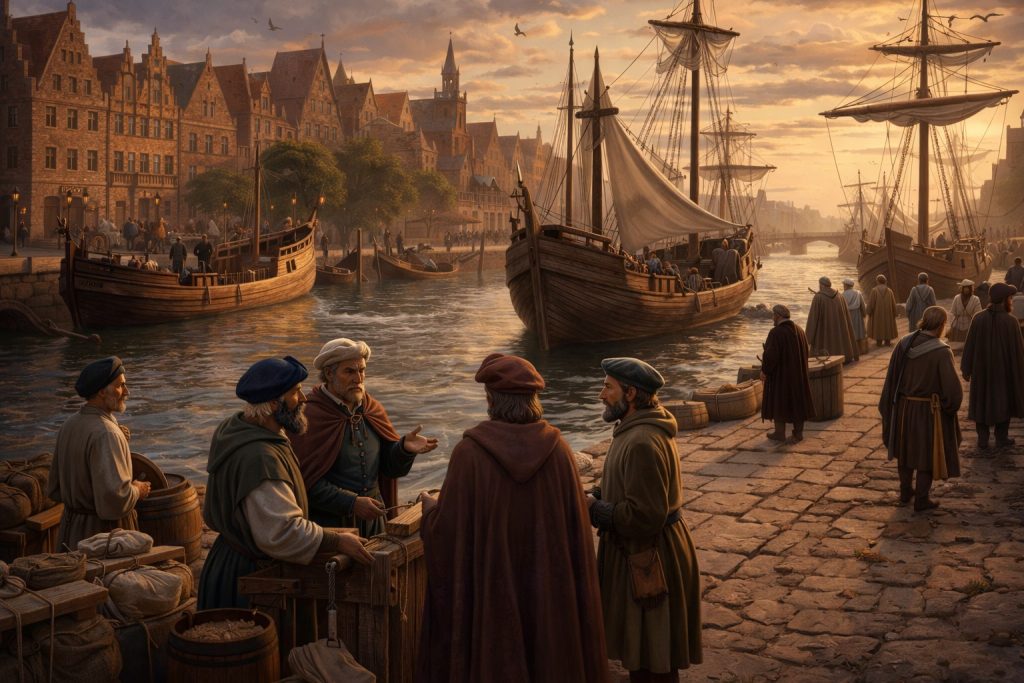
Unlike empires built through conquest, the Hanseatic League grew through cooperation, shared interests, and geographic advantage.
Geographic Foundations of the Hanseatic Network
The success of the Hanseatic League was deeply rooted in geography. Coastal access, navigable rivers, and proximity to resource-rich regions allowed cities like Lübeck, Hamburg, and Riga to dominate trade in timber, grain, fish, and salt.
Rivers such as the Elbe and Vistula connected inland producers to maritime markets, transforming geography into an economic asset. Control of key ports meant control over supply chains, giving merchant cities influence far beyond their political borders.
Trade as a Source of Political Influence
Although the Hanseatic League was not a formal state, its economic power translated into political leverage. Member cities negotiated trade privileges, enforced commercial rules, and even waged wars to protect their interests.
This network demonstrated how geography-enabled trade could rival traditional political authority. By coordinating across regions, merchants shaped laws, diplomacy, and urban development throughout Northern Europe.
Decline and Historical Significance
The League gradually declined as nation-states strengthened and global trade shifted toward Atlantic routes. However, its legacy remains visible in the urban layouts, architectural styles, and economic traditions of Northern European cities.
More importantly, the Hanseatic League illustrates how geography, when combined with cooperation, can produce influence without centralized rule—a lesson that remains relevant in today’s interconnected world.
Conclusion
The Hanseatic League shows that geography does not merely constrain human activity; it enables innovation, cooperation, and power. By understanding how medieval trade networks functioned, we gain insight into the foundations of modern economic geography.